Fourier Transform in Radar and Signal Processing
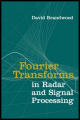
This text presents an integrated approach to carrying out Fourier transforms and establishes a unified system, details how complex functions can be broken down for analysis, and much more.
 TABLE OF CONTENTS
 It has already been remarked that the problem of delay equalization as considered here has been covered in Section 5.3 under the subject of sampled waveform delay, so no further illustrations are given here. However, the subject of amplitude equalization has not been illustrated before, so a simple example, using the results of Section 6.3 above, is presented in this section, showing how effective the method is and with how little computation if there is a degree of oversampling. We take the simple case of a linear amplitude distortion with an unweighted squared error function over the bandwidth (equivalent to a rect function power spectrum). The response to be matched is of the form G( f) = 1 + af over the bandwidth (taken to be unity), or G( f) = rect f + ( a/2) ramp f. The Fourier transforms of G required for the components of a will include a transform of the ramp function, that is, a snc 1 function, as well as a snc 0 from the rect function. As we require the transform of G 2( f) to determine the elements of B, we also have a ramp 2 function with its transform snc 2. There is an important detail to notice in that they are actually inverse Fourier transforms that are required [see (6.6) and (6.7)]. In many cases (using...