Fundamentals and Applications of Microfluidics
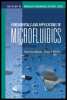
This forward-looking book explains how to take advantage of the performance benefits of microfluidics and serves as a reference for technology and applications in this area.
 TABLE OF CONTENTS
 Although everyone has an intuitive sense of what a fluid is, rigorously defining just what fluids are is more troublesome. According to Merriam-Webster's Collegiate Dictionary [1], a fluid is: "a substance (as a liquid or gas) tending to flow or conform to the outline of its container."
While this definition gives us a sense of what a fluid is, it is far removed from a technical definition. It also begs the question: What is a liquid or a gas? Again, according to [1], a liquid is: "a fluid (as water) that has no independent shape but has a definite volume and does not expand indefinitely and that is only slightly compressible," while a gas is: "a fluid (as air) that has neither independent shape nor volume but tends to expand indefinitely."
These definitions are circular and ultimately rely on examples such as water and air to explain what a fluid is. Clearly we must look further for a good definition of what a fluid is.
According to one of the leading undergraduate textbooks in fluid mechanics [2], the definition of a fluid is: "a substance that deforms continuously under the application of shear (tangential) stress, no matter how small that stress may be." This definition proves to be a suitable working definition that we can use to determine whether some material that is not air or water is a fluid.
Consider a thought experiment wherein both a solid block of material and a layer of fluid are...