Fundamentals and Applications of Microfluidics

This forward-looking book explains how to take advantage of the performance benefits of microfluidics and serves as a reference for technology and applications in this area.
 TABLE OF CONTENTS
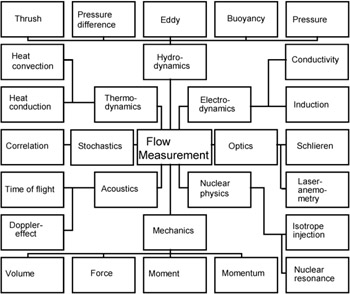
 Microflow sensors are another important component for controlling fluid flow in a microfluidic system. Microflow sensors could complement microvalves and micropumps in a control loop. Since flow measurement is a classical field of measurement technology, the sensing principles include almost all fields of physics (Figure 8.1). Similar to other microfluidic components, the first approach of designing microflow sensors follows conventional concepts, which readily exist in large scales. Governed by their small geometry, the biggest advantages of microflow sensors are the low energy consumption and the ability to measure very small flow rates on the order of microliters per minute to nanoliters per minute.
Different parameters determine the performance of a microflow sensor: the dynamic range of operation, sensitivity, response time, power consumption, bio-compatibility, and chemical compatibility.
The range of operation is limited by the maximum flow velocity or flow rate the sensor can measure. The flow range can be adjusted by geometrical parameters, sensor materials, and the sensing principle.
The sensitivity is defined as the derivative of the sensor signal V with respect to the flow rate  or flow velocity u:
| (8.1) | 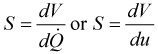 |
For nonlinear characteristics, one can use the zero-sensitivity S 0 at zero flow rate:
| (8.2) | 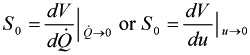 |
The response time is defined as the time the sensor signal requires to stabilize after a change in flow rate.
The power consumption depends on the sensor principle. Because of their tiny size, micromachined thermal flow sensors...