Fundamentals and Applications of Microfluidics
This forward-looking book explains how to take advantage of the performance benefits of microfluidics and serves as a reference for technology and applications in this area.
 TABLE OF CONTENTS
 Micromachining technology offers great opportunities to biomedical instrumentation. One of the most common and simplest biomedical instruments is the needle. Traditionally, needles are used for delivering drugs and aspirating body fluid through the human skin. The smallest needles fabricated by conventional machining methods have a minimum diameter on the order of 300 ?m.
Micromachining technology is able to fabricate needles smaller than the limit of 300 ?m. The small size opens new application fields for this simple device. The main applications of microneedles are:
Painless drug delivery through skin;
Closed-loop chemical stimulation of tissues;
Cell manipulation;
Sample collection and delivery in chemical and biochemical analysis;
Interconnection between microscopic and macroscopic fluidic systems.
Figure 9.5 shows the structure of human skin. The outer layer is the stratum corneum (SC), which is 10 ?m to 15 ?m thick and is a dead tissue. The next layer is viable epidermis (VE) with a thickness of about 50 ?m to 100 ?m. This tissue layer consists of living cells, which have blood vessels capable of transporting drugs, but contains very few nerves.
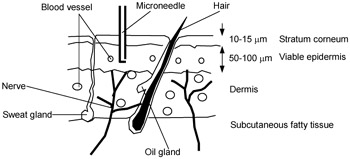
If a microneedle can reach the region of VE, it would be able to deliver drugs without pain. The microneedle should penetrate into the skin from 15 ?m to 100 ?m in order to fulfill this function. In transdermal drug delivery, microneedles are only needed to puncture the skin. The tiny pores...