Fundamentals and Applications of Microfluidics
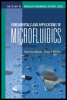
This forward-looking book explains how to take advantage of the performance benefits of microfluidics and serves as a reference for technology and applications in this area.
 TABLE OF CONTENTS
 | 9.1 | A membrane filter is made of single crystalline silicon. The membrane is 10 ?m thick and has the shape of a 1 mm 1 mm square. Filter pores are etched in the membrane using DRIE. Each rectangular pore measures 10 ?m 10 ?m. The center distances of the pores are 15 ?m. Determine the maximum water flow rate that the filter can withstand. |
| 9.2 | A microneedle is made of single crystalline silicon. The channel is 1.5 mm long and has a width of 100 ?m and a height of 200 ?m. The needle wall is 20 ?m thick. Determine:
|
| 9.3 | Water is to mix with nitric acid at room temperature in a micro Y-mixer. Design the mixing channel if the flow rate of water and nitric acid are both 5 ?l/min. The channel is 50 ?m in width and 150 ?m in depth. The channel should be fitted into a rectangular area with edge ratio of 3:2. |
| 9.4 | With the same conditions in Problem 9.3, design a parallel lamination mixer so that the length of the mixing channel cannot exceed 2 mm. |
| 9.5 | How many mixing stages does a sequential mixer require for the same time performance of the mixer designed in Problem... |