Fundamentals and Applications of Microfluidics
This forward-looking book explains how to take advantage of the performance benefits of microfluidics and serves as a reference for technology and applications in this area.
 TABLE OF CONTENTS
 Microfilters discussed in Section 9.1 can be considered one type of microseparator. While microfilters discriminate particles based on their geometrical size, other microseparators are based on other physical properties such as diffusion coefficient, mass, and electrical charge.
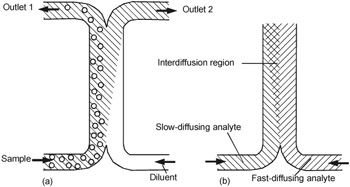
In a low Reynolds number regime, a diluent stream such as water is forced into a channel with a sample stream. The same situation occurs in the Y-mixer, if the sample stream contains different species, which have different diffusion coefficients. Smaller species usually have higher diffusion coefficients and quickly diffuse into the diluent stream.
Brody et al. implemented this concept in a microfluidic device [137]. The channels are etched in silicon with EDP and are 10 ?m deep. The device is tested by filtering fluorescent dye carboxyfluorescein from 0.6- ?m-diameter fluorescent polystyrene spheres. Both species are mixed in one fluid stream. The first one is a relatively small molecule, and thus has a higher diffusion coefficient. Small molecules are extracted from the large particles and sent to the outlet [Figure 9.36(a)]. The same principle is used for monitoring quickly diffusing molecules. This so-called T-sensor can measure sample concentrations in a continuous-flow system [Figure 9.36(b)] [134].
In microfluidic systems, microseparators are extremely useful tools for injection analysis. This section focuses on microseparators for analysis applications. Based on the different separation concepts, the devices are categorized as gas chromatography, liquid chromatography, and electrophoresis. Electrophoresis is further divided...