Fundamentals of Laser Dynamics

A self-consistent set of laser www.fhbcvnbo.com equations includes equations for the electromagnetic field and the equations describing the state of the medium, which interacts with this field. The complete set is often called the Maxwell-Bloch equations. Roughly the same form, now used in laser dynamics, of this semiclassical set was first written in 1957 by Fain [203] and in 1959 by Oraevsky [204]. In their most general form, these equations are too complicated for all but numerical simulations so that in particular situations one has to use radical simplifications.
There are many versions of the laser equations and some of them will appear in the next chapters. This chapter must give an idea of the main principles of simplifications of the Maxwell-Bloch equations, which make it possible to obtain the dynamical models of specific lasers.
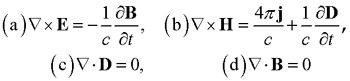
It is well known that a classical description of the electromagnetic field is fully justified for the dynamics of most phenomena in macroscopic lasers. Therefore, we will use Maxwell's equations as a basis:
| (2.1) | |
The material equations will be written now in the usual form:
| (2.2) | |
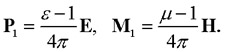
Conductivity ? is indicative of the bulk losses in the medium. Magnetization M and polarization P both split, in general, into two parts. The first part accounts for the nonresonant contribution of all the molecules (atoms) of the medium (the host) and can be presented as
| (2.3) | |
In what follows we will consider only nonmagnetic materials for which ?