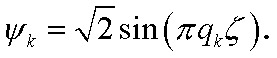
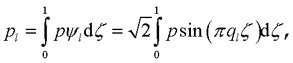
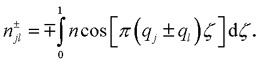
The concept of induced inversion gratings is mostly simply realized in the basic models of multimode lasers if the consideration is limited by the set of longitudinal modes
Here we must distinguish cases of large ( ? c >> ?) and small ( ? c << ?) intermode frequency spacing.
The starting point for further transformations is the set of equations (4.2) that might be described using the time normalization condition ? = ? ? t in the form
| (S.1a) | 
|
| (S.1b) | 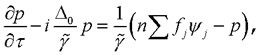
|
| (S.1c) | 
|
In the case of large intermode frequency spacing and many modes it is convenient to take the reference frequency ? equal to ? 0, so that ? 0 = 0. Let us introduce the quantity
that represents the amplitude of the polarization grating. Now we can rewrite the equation (S.1a) in the form
| (S.2) | 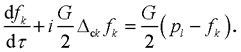
|
Let us multiply Eq (S.1b) on ? j and integrate on the cavity perimeter that leads us to the equation
| (S.3) | 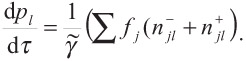
|
So far as the field and polarization amplitudes have the time dependence like exp(- i ? k ?), the procedure of adiabatic elimination of the polarization amplitude leads to the relation
| (S.4) | 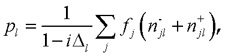
|
where
Note that  and
and  . Bearing this in mind we can rewrite (S.4) as
| (S.6) | 
|
Next, using obtained results, we will transform Eq. (S.1c) into equations for the inversion gratings amplitudes
| (S.7) | 
|
As in Eq. (4.1.1), we ignore the combination sums in Eq. (S.6) when we substitute p j
Copyright Ya I Khanin 2006 under license agreement with Books24x7


 TABLE OF CONTENTS