Fundamentals of Laser Dynamics

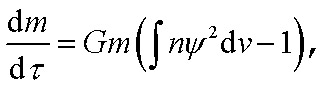
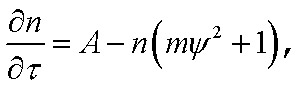
The single-mode model of standing wave laser is described by a set of Eqs. (2.76). Since we deal with class B laser, it is possible to eliminate adiabatically the atomic polarization, which leads, in the absence of detuning, to the rate equations
| (3.54a) | |
| (3.54b) | |
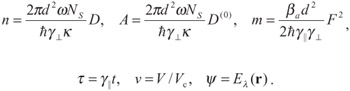
where
| (3.55) | |
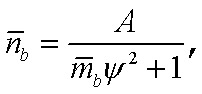
One steady state of Eqs. (3.54), namely m a = 0, n a = A, is easy to find. The others are determined from
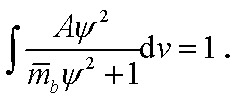
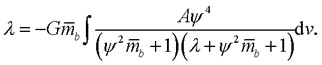
| (3.56) | |
| (3.57) | |
The number of nontrivial steady states is equal to the number of the real positive roots of Eq. (3.57). In the simplest case, the population inversion is created over the entire volume of the laser rod, as assumed. At A > 1, the left-hand side of Eq. (3.57) is a monotonically decreasing function of m b and, therefore, this equation has an unique root.
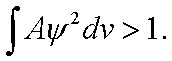
The zero branch of solutions becomes unstable if the self-excitation condition
| (3.58) | |
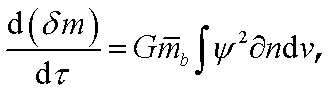
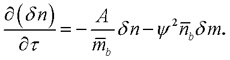
is satisfied. In order to investigate the stability of the nontrivial branch of solutions, we linearize Eq. (3.54) in the vicinity of the states m = m b, n = n b:
| (3.59a) | |
| (3.59b) | |
On assuming a perturbation of form { ?m, ?n} = { ?m 0, ?n 0} e ??, resolving (3.59b) with respect to ? n 0 and substituting the results into (3.59a), we arrive at a characteristic equation
| (3.60) | |
Our further...