Fundamentals of Laser Dynamics

Chapter 3: Single-Mode Lasers

The simplest single-mode models play a special role in the dynamic laser theories. They possess extremely low dimensions and include only the most fundamental and unavoidable nonlinearity that accompanies the process of matter-field interaction but do not cover the mode interaction, additional nonlinear elements and external signals. The behaviour of single-mode lasers depends on the dynamical class they belong to.

3.1. Dynamical Models of Homogeneously Broadened Lasers

In what follows we often use equations written in dimensionless form. The advantage of using this form is its simplicity owing to which it is possible to 'hide' almost all the coefficients not defined in the experiment. Meanwhile, the normalization of the observed quantities has a clear physical meaning: the field amplitude is normalized to saturation value and the inversion is normalized to a value corresponding to the laser threshold.

3.1.1. Equations for the Quadratic Quantities

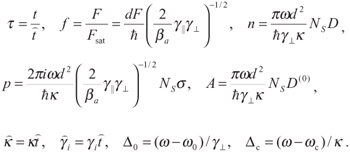
We now turn to the laser model expressed by Eqs. (2.75). If he losses for the separate cavity elements (mirrors) are small and, therefore, there are no areas of abrupt field increase or decrease inside the cavity, then we can assume ?F/ ?z = 0. Let us introduce a table of dimensionless symbols:

(3.1)

It is most convenient to choose a normalization factor comparable with a time scale of the time-dependent process in a laser. The hard unification of this factor is not reasonable. The variety of possibilities dictates the individual choice in each concrete situation. We will use inverse relaxation rates

UNLIMITED FREE
ACCESS
TO THE WORLD'S BEST IDEAS

SUBMIT
Already a GlobalSpec user? Log in.

This is embarrasing...

An error occurred while processing the form. Please try again in a few minutes.

Customize Your GlobalSpec Experience

Category: Fiber Lasers
Finish!
Privacy Policy

This is embarrasing...

An error occurred while processing the form. Please try again in a few minutes.