Fundamentals of Laser Dynamics

Parameter modulation is an effective method to control the laser behaviour. A relatively weak periodic modulation is capable of producing a much stronger response in the laser output. Owing to the system nonlinearity this response can be not only regular but also chaotic.
Due to the high sensitivity of lasers to external modulation, uncontrolled parameter variations during the laser operation can produce random spiking.
Thus, there is considerable interest in nonautonomous laser models both for control of the emission and for interpretation of spontaneous time-dependent phenomena.
We will focus our discussion on the response of class B lasers to weak periodic modulations of parameters [96, 450 457]. There are four important parameters accessible for modulation in the models we have considered: ?, A, ? tr and ? ?. However, the last parameter is relatively insensitive to variation of the external conditions, therefore, it is generally more interesting to study the laser behaviour when one of the other three parameters is modulated.
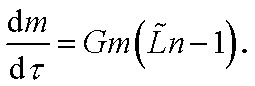
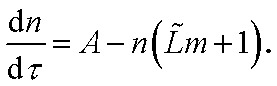
Our discussion is based on the rate equations (3.11):
| (6.1a) | |
| (6.1b) | |
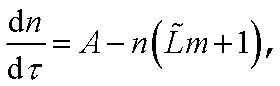
Assume first that the cavity losses are modulated harmonically and, therefore, Eqs. (6.1) are replaced by
| (6.2a) | |
| (6.2b) | |
where ? loss is the depth of loss modulation.
Since Eqs. (6.2) contain lime explicitly, they have no time-independent solutions. Only in the limit ? loss ? 0 do the solutions of these equations tend to the...