Fundamentals of Laser Dynamics

The model considered below is based on the assumption that a unique cavity mode is excited and that the laser medium is homogeneous (spectrally and spatially). These assumptions are best satisfied by a unidirectional ring laser. However, the spatial uniformity of inversion is also provided if a large number of modes of a standing wave type under the approximately equal conditions are involved in the laser action. The rate equations for total radiation intensity and population difference in such a multimode laser look like those for a single-mode laser Eq. (3.11), which are considered in what follows.
With time normalized to
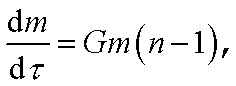
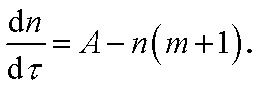
and with exact coincidence of the cavity eigenfrequency and the laser transition frequency, Eqs. (3.11) become
| (3.14a) | |
| (3.14b) | |
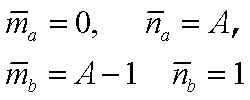
The fixed points of the set of rate equations (3.14) and the solutions in their vicinity have been considered by many authors [231, 232, 237 243]. The steady states
| (3.15) | |
can be readily found from (3.14) provided d/d ? = 0. The type of the fixed points can be specified by linearizing the Eqs. (3.14) in the vicinity of each of them with respect to small deviations ?m = m - m, ?n = n - n.
The following linearized equations
hold near point a. Substitution of the solutions { ?m, ?n} = { ?m', ?n'} e ?? into these equations leads to...