Handbook of Plastics, Elastomers, and Composites, Fourth Edition
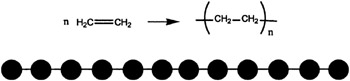
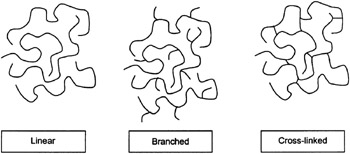
A polymer is prepared by stringing together a series of low-molecular-weight species (such as ethylene) into an extremely long chain (polyethylene), much as one would string together a series of bead to make a necklace (see Fig. 1.1). The chemical characteristics of the starting low-molecular-weight species will determine the properties of the final polymer. When two different low-molecular-weight species are polymerized the resulting polymer is termed a copolymer such as ethylene vinylacetate. This is depicted in Fig. 1.2. Plastics can also be separated into thermoplastics and thermosets. A thermoplastic material is a high-molecular-weight polymer that is not cross-linked. It can exist in either a linear or a branched structure. Upon heating, thermoplastics soften and melt, which allows them to be shaped using plastics processing equipment. A thermoset has all of the chains tied together with covalent bonds in a three dimensional network (cross-linked). Thermoset materials will not flow once cross-linked, but a thermoplastic material can be reprocessed simply by heating it to the appropriate temperature. The different types of structures are shown in Fig. 1.3. The properties of different polymers can vary widely; for example, the modulus can vary from 1 MPa to 50 GPa. Properties can be varied for each individual plastic material as well, simply by varying the microstructure of the material.
There are two primary polymerization approaches: step-reaction polymerization and chain-reaction polymerization.1 In step-reaction (also...