Handbook of Plastics, Elastomers, and Composites, Fourth Edition
Processing involves the conversion of the solid polymer into a desirable size and shape. There are a number of methods to shape the polymer, including injection molding, extrusion, thermoforming, blow molding, and rotational molding. The plastic material is heated to the appropriate temperature for it to flow, and the material is shaped and then cooled to preserve the desired shape.
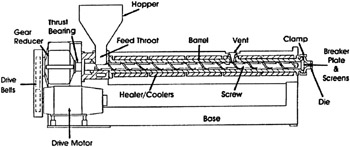
Extruders are used to continuously produce rods or sheets; this is the method used to produce PVC pipes, profiled PVC window moldings, and sheets of all sorts of plastics such as PC (Lexan ) and PMMA (Plexiglass ) for applications including storm doors. Extruders can continuously produce shapes of any cross section and are thus used to manufacture garden hoses, gutters, floor tiles, sealing strips for car windows and doors, and to coat wire insulation, among other applications. This method was adapted from metallurgists who use a similar form of extrusion to process molten aluminum, and it was first adapted in 1845 by Bewley and Brooman to extrude rubber around cable as a coating. 418 As a most basic description, extruders are a machine with a drive system (motor, gearbox, and thrust bearing), a plasticating unit (with at least one Archimedes-type screw, a barrel, and a temperature control system) and a control cabinet with control devices and the power supply. 419 Figure 1.54 shows a single-screw extruder. 420
Plastic pellets are fed into the cavity between the screw and...