Handbook of Plastics, Elastomers, and Composites, Fourth Edition
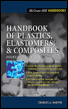
Edward M.Petrie
Materials and Process Center
ABB Transmission Technology Institute
Raleigh, North Carolina
To fabricate large plastic assemblies, the most cost-effective method often involves producing smaller subsections and joining them together. In such cases, the fabricator has a variety of joining options to consider, including
Adhesive bonding
Thermal welding
Solvent cementing
Mechanical fastening
The strength of the plastic assembly relies heavily on the characteristics of the joint. In most applications, the joint must be nearly as strong as the substrate throughout the expected life of the product. The method chosen to join plastics should be carefully evaluated. In addition to strength and permanence, consideration must be given to tooling cost, labor and energy cost, production time, appearance of the final part, and disassembly requirements. Some plastic materials will be better suited for certain joining processes than others due to their physical and chemical characteristics.
A consideration in plastic assembly that is usually not dominant when joining other substrates is the time it takes to complete the joining operation. Plastic products generally require very fast, high-volume assembly processes in industries such as consumer products, automotive, and packaging. Speed, simplicity, and reliability are key concerns in most of these high-volume assembly processes.
Speed and simplicity are usually considered to be of greater value than reliability or durability when bonding commodity plastic substrates. Because of the nature of the polymeric substrate and the type of applications for which such materials are best suited, exceedingly high strength and...