Overview
Ruben J.Hernandez, PhD
School of Packaging
Michigan State University
East Lansing, Michigan
Plastics are used extensively in packaging due to their outstanding physical, mechanical, and chemical properties. Plastic are readily available; versatile; easy to process either singly, as multi-plastic, or in combination with other materials such as glass, metal, or cellulose-base; and relatively low in cost. The use of plastics has grown faster than any other group of materials in the packaging industry. The vigorous growth has been driven by a material substitution trend, the flexibility in design, and wide range in product protection. In the last two decades, there has been a strong expansion of the use of plastics, especially in the food and pharmaceutical industries. Market specialty niches like snack foods, baby foods, aseptic food packages, beverages, microwavable foods, and modified atmosphere packaging are examples of popular applications for plastics. Packaging is the largest single application for plastics. As illustrated in Fig. 11.1, in 1997, packaging accounted for about 26 percent of all plastics used in the U.S.A.
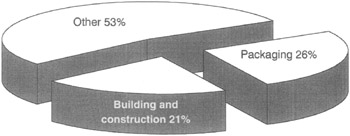 Figure 11.1: U.S. plastic markets, 1997. (Source: R.J.Hernandez, S.E.Selke, and J.D.Culter, Plastic Packaging, Properties, Processing, Applications and Regulations, Hanser, 2000)
 Plastics are used in packaging in diverse forms: single films, sheets, multilayer coextruded structures, sheets, coatings, adhesives, foams, laminations, and rigid and semi-rigid containers. A great variety of products are packaged, delivered, and distributed around the nation and world using plastics. Examples of these products include solids, liquids, chemicals, alkalis, acids, electronics, hardware, foods, beverages, and health-care products. In...

 TABLE OF CONTENTS