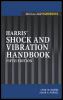
Harris' Shock and Vibration Handbook

Chapter 8: Transient Response to Step and Pulse Functions

Robert S. Ayre

INTRODUCTION

In analyses involving shock and transient vibration, it is essential in most instances to begin with the time-history of a quantity that describes a motion, usually displacement, velocity, or acceleration. The method of reducing the time-history depends upon the purpose for which the reduced data will be used. When the purpose is to compare shock motions, to design equipment to withstand shock, or to formulate a laboratory test as means to simulate an environmental condition, the response spectrum is found to be a useful concept. This concept in data reduction is discussed in Chap. 23, and its application to environmental conditions is discussed in Chap. 24.

This chapter deals briefly with methods of analysis for obtaining the response spectrum from the time-history, and includes in graphical form certain significant spectra for various regular step- and pulse-type excitations. The usual concept of the response spectrum is based upon the single degree-of-freedom system, usually considered linear and undamped, although useful information sometimes can be obtained by introducing nonlinearity or damping. The single degree-of-freedom system is considered to be subjected to the shock or transient vibration, and its response determined.

The response spectrum is a graphical presentation of a selected quantity in the response taken with reference to a quantity in the excitation. It is plotted as a function of a dimensionless parameter that includes the natural period of the responding system and a significant period of the excitation. The excitation may be defined in terms of...

UNLIMITED FREE
ACCESS
TO THE WORLD'S BEST IDEAS

SUBMIT
Already a GlobalSpec user? Log in.

This is embarrasing...

An error occurred while processing the form. Please try again in a few minutes.

Customize Your GlobalSpec Experience

Category: Shock and Vibration Testing Shakers
Finish!
Privacy Policy

This is embarrasing...

An error occurred while processing the form. Please try again in a few minutes.