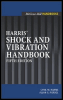
Harris' Shock and Vibration Handbook

The damping of an element of a structural system is a measure of the rate of energy dissipation which takes place during cyclic deformation. In general, the greater the energy dissipation, the less the likelihood of high vibration amplitudes or of high noise radiation, other things being equal. Damping treatments are configurations of mechanical or material elements designed to dissipate sufficient vibrational energy to control vibrations or noise.
Proper design of damping treatments requires the selection of appropriate damping materials, location(s) of the treatment, and choice of configurations which assure the transfer of deformations from the structure to the damping elements. These aspects of damping treatments are discussed in this chapter, along with relevant background information including:
Internal mechanisms of damping
External mechanisms of damping
Polymeric and elastomeric materials
Analytical modeling of complex modulus behavior
Benefits of applied damping treatments
Free-layer damping treatments
Constrained-layer damping treatments
Integral damping treatments
Tuned dampers and damping links
Measures or criteria of damping
Methods for measuring complex modulus properties
Commercial test systems
There are many mechanisms that dissipate vibrational energy in the form of heat within the volume of a material element as it is deformed. Each such mechanism is associated with internal atomic or molecular reconstructions of the microstructure or with thermal effects. Only one or two mechanisms may be dominant for specific materials (metals, alloys, intermetallic compounds, etc.) under specific conditions,...