Harris' Shock and Vibration Handbook

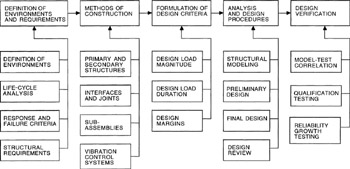
Equipment is defined here as any assembly of parts that form a single functional unit for the purposes of manufacturing, maintenance, and/or recordkeeping, e.g., an electronic package or a gearbox. Designing equipment for shock and vibration environments is a process that requires attention to many details. Frequently, competing requirements must be balanced to arrive at an acceptable design. This chapter guides the equipment designer through the various phases of a design process, starting with a clear definition of the requirements and proceeding through final testing, as illustrated in Fig. 41.1.
The critical first step in the design of any equipment is to understand and clearly define where the equipment will be used and what it is expected to do. The principal environments of interest in this handbook are shock and vibration (dynamic excitations), but the equipment typically will be exposed to many other environments (see Table 20.1). These other environments may occur in sequence or simultaneously with the dynamic environments.In either case, they can adversely affect the dynamic performance of the materials used in a design. For example, a thermal environment can directly affect the strength, stiffness, and damping properties of materials. Other environments can also indirectly affect the dynamic performance of an equipment design. For example, thermal environments can produce differential expansions and contractions that may sufficiently prestress critical structural elements to make...