Harris' Shock and Vibration Handbook

For current approaches to experimental modal analysis, the frequency response function is the most important, and most common, measurement to be made. When estimating frequency response functions, a measurement model is needed that allows the frequency response function to be estimated from measured input and output data in the presence of noise (errors). These errors have been discussed in this and other chapters in great detail.
There are at least four different testing configurations that can be considered. These different testing conditions are largely a function of the number of acquisition channels or excitation sources that are available to the test engineer.
Single input/single output (SISO)
Single input/multiple output (SIMO)
Multiple input/single output (MISO)
Multiple input/multiple output (MIMO)
In general, the best testing situation is the multiple input/multiple output configuration (MIMO), since the data are collected in the shortest possible time with the fewest changes in the test conditions.
The estimation of the frequency response function depends upon the transformation of data from the time to the frequency domain. The Fourier transform is used for this computation. The computation is performed digitally using a fast Fourier transform algorithm. The frequency response functions satisfy the following single and multiple input relationships:
Single input relationship:
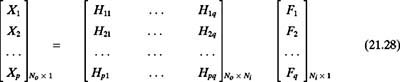
Multiple input relationship:
The most reasonable, and most common, approach to the estimation of frequency response functions is the use of least squares (LS) or total least squares (TLS) techniques. [8], [9] These are standard techniques for...