Harris' Shock and Vibration Handbook

This chapter describes the principles of operation of typical instrumentation used in the measurement of shock and vibration. It deals with the measurement of parameters which characterize the total (broad-band) signal. Considerable reference is made to Chaps. 22 and 23, which give the mathematical background for various signal descriptors. Some reference is also made to the digital techniques of Chap. 27. Many of the techniques introduced here are applied in Chap. 16.
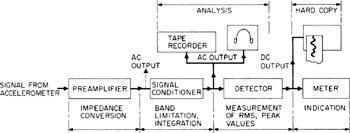
Figure 13.1 shows a typical measurement system consisting of a preamplifier, a signal conditioner, a detector, and an indicating meter. Most or all of these elements often are combined into a single unit called a vibration meter, which is described in a following section.
The preamplifier is required to convert the very weak signal at high impedance from a typical piezoelectric transducer into a voltage signal at low impedance, which is less prone to the influence of external effects such as electromagnetic noise pickup. The signal conditioner is used to limit the frequency range of the signal (possibly to integrate it from acceleration to velocity and/or displacement) and to provide extra amplification. The detector is used to extract from the signal, parameters which characterize it, such as rms value, peak values, and crest factor. The so-called dc or slowly varying signal from the detector can be viewed on a meter, graphically recorded, or digitized and stored in a digital...