Harris' Shock and Vibration Handbook

This chapter deals primarily with frequency analysis, but a number of related analysis techniques namely, synchronous averaging, cepstrum analysis, and Hilbert transform techniques are considered.
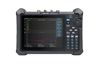
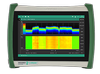
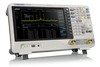
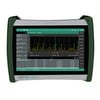
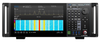
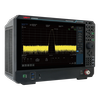
With the increase in availability of signal processing packages, virtually all of the techniques discussed, and a large number of others, can now be directly programmed by the user on a general purpose computer (see Chap. 27), but dedicated analyzers still have a number of advantages, as follows:
Dedicated hardware for preprocessing signals before they are actually stored in the analyzer's memory. This includes real-time zoom with decimation to a lower sampling frequency (vastly reducing the amount of data to be stored), real-time digital resampling for order analysis, and even something as trivial as real-time triggering. If the data only has to be processed after the occurrence of some event that can be used as a trigger, the latter can avoid the storage and postprocessing of vast amounts of useless data.
Fractional octave digital filter analyzers decimate the sampling frequency of low-frequency signal components as part of their operation. If the equivalent analysis over three frequency decades were to be carried out by postprocessing of an already digitized signal, approximately one million samples would be required to obtain a single one-twelfth-octave spectrum with sufficient averaging for a random signal.
Dedicated analyzers are more likely to provide error-free results in terms of correct scaling as rms spectra, power spectra, power spectral density, or energy spectral density, while compensating for the data windows used. They...