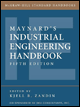
Maynard's Industrial Engineering Handbook, Fifth Edition
This chapter details the procedures for creating charts and diagrams used to portray and analyze work processes or work cycles. For clarity in referring to particular types of these representational aids, we distinguish between diagrams and charts. Diagrams typically portray the physical space traversed by the object being analyzed. Charts are symbolic representations that portray activity elements in processes or work cycles. In both cases these aids are useful as communication devices, which, in addition to representing a process, lend themselves to analyses that support methods improvements. Charts and diagrams are used in process design, facility design, and in process or facility redesign. They are also very useful as training aids.
The most beneficial tools used during either the initial stage of design or in the analysis of an existing process or a facility are those that provide a visual representation of the whole system or subsystem under study. In general, the diagrammatic representations take the form of flow process diagrams or link diagrams. In both cases, there is an "overhead" or plan view schematic representation of the process with lines tracing the flow of the object of interest.
In the case of a flow diagram (see Fig. 17.1.1), the object being diagrammed could be material, people, lift trucks, piece parts, subassemblies, and the like the objective is to portray the flow and relationships among activities in physical space.