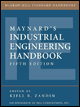
Maynard's Industrial Engineering Handbook, Fifth Edition
Where, despite the visibility of mass production, low quantity production still represents between 50 and 75 percent of all manufacturing, methods have been developed to improve the efficiency of low quantity production. The similarities of parts, either from a design or a manufacturing point of view, can be used for design and manufacturing standardization, which in turn can lead to cell manufacturing. This technique is called group technology.
While the introduction of the steam-driven engine in the nineteenth century is most often recalled as the major step forward in the Industrial Revolution, there were many other developments that have contributed to modern manufacturing as we now know it. For example, the early 1920s were highlighted by steps in the optimization of design and manufacturing processes for mass production on a great scale. When hundreds of thousands or millions of units are being produced, a very small change in efficiency can lead to a very great gain in cost savings.
In recent years, there has been a steady stream of improvements in the technology of mass production, many of them enabled by the emergence of computerization. The quality of everyday life in the second half of the twentieth century would have been much different without these optimized mass production processes.
We do not live in a mass-produced world, however. In fact, most of the things we have and use are not made on assembly lines. They are produced in relatively small...