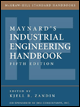
Maynard's Industrial Engineering Handbook, Fifth Edition
As with any measurement, the measurement of work brings knowledge. Through this knowledge, factual decisions and improvements can be made and could be exercised. Work measurement has for a long time been a sound management tool to be used as a basis for planning and scheduling, estimation of costs, and evaluation of performance. In essence, managers are looking at work measurement as a means to satisfy their desire and need to know, and predict with confidence.
Scientifically developed work measurement tools have been available to the industrial engineer since the late 1800s. A variety of such tools are now being used in a large variety of industries worldwide.
In search of accuracy, consistency, and speed, predetermined motion time systems were first being developed during the mid-1920s starting with motion time analysis (MTA). Methods time measurement (MTM), published in 1948, became the foundation for many simplified and more efficient techniques. One of the most recent MTM-based techniques that is easy to learn and fast to use is MOST work measurement systems.
This chapter will provide an overview of the concept and principles of MOST work measurement systems including BasicMOST, MiniMOST, and MaxiMOST. Several examples will illustrate the application of MOST for different activities.
Because industrial engineers are trained to accept that with sufficient study any method can be improved, many efforts have been made to simplify the analyst's work measurement task. This has, for instance, led to a...