Introduction to Code Division Multiple Access (CDMA): Network, Services, Technologies, and Operation

Frequency reuse is the process of using the same radio frequencies on radio transmitter sites within a geographic area that are separated by sufficient distance to cause minimal interference with each other. Frequency reuse allows for a dramatic increase in the number of customers that can be served (capacity) within a geographic area on a limited amount of radio spectrum (limited number of radio channels). The ability to reuse frequencies depends on various factors that include the ability of channels to operate in with interference signal energy attenuation between the transmitters.
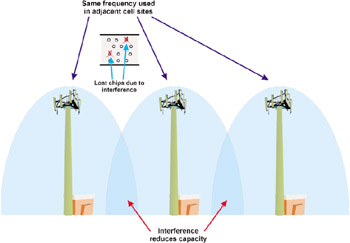
The IS-95 CDMA and CDMA radio channels use coded channels that are uniquely assigned to each user. This allows many users to operate on the same frequency. This also allows frequencies to be reused in every cell site and sectors within a cell site. However, the use of the same frequency in the same cell site and sector increases the interference levels and decreases the capacity of the radio channels.
Figure 1.10 shows how CDMA systems can reuse the same frequency in each cell site. This example shows that the frequency use factor is 1 (N=1) and that the overlap of the radio channels results in an increased interference level in the overlapping area. Because multiple chips represent each channel, this overlap simply results in the loss of some of the chips and this reduces the capacity of the CDMA system.
Using the same frequency in each cell site within a cellular...