Introduction to Code Division Multiple Access (CDMA): Network, Services, Technologies, and Operation

Channel structure is the division and coordination of a communication channel (information transfer) into logical channels, frames (groups) of data, and fields within the frames that hold specific types of information.
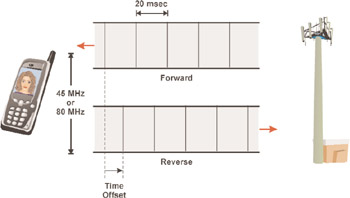
Each CDMA communication channel is composed of a radio channel pairs. A channel pair is composed of one forward channel (base station to mobile device) and a reverse channel (mobile device to the base station). Each coded traffic channel is divided into 20 msec frames and each 20 msec frames are divided into 1.25 msec time slots. These time slots are called power control groups.
Figure 1.11 shows the channel structure and duplex channel spacing for the IS-95 CDMA system. This diagram shows that each coded communication channel (traffic channel) is divided into 20 msec frames an that each of the frames is divided into 1.25 msec time slots (power control groups). This example also shows that the duplex channel spacing varies based on the frequency band. At 800 MHz, the duplex channel spacing is 45 MHz and at 1.9 GHz, the duplex channel spacing is 80 MHz. The 20 msec frames for the forward and reverse channels may be transmitted with a time offset relative to each other. The ability to change the time offset can be used to coordinate the transmission of power control groups.