Introduction to Computational Fluid Dynamics

For advanced undergraduate and first year graduate students in mechanical, aerospace and chemical engineering, this textbook emphasizes understanding CFD through physical principles and examples.
 TABLE OF CONTENTS
 In the previous chapter, we considered convective-diffusive transport in long ( x direction) and thin ( y direction) flows. This implied that although convective fluxes were significant in both x and y directions, significant diffusion fluxes occurred only in the y direction; diffusion fluxes in the x direction are negligible. We now turn our attention to flows in which diffusive fluxes are comparable in both x and y directions. Thus, the general transport Equation (1.25) may be written [1] as
| (5.1) |  |
where
| (5.2) | 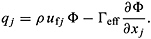 |
In Equation 5.2, the first term on the right-hand side represents the convective flux whereas the second term represents the diffusive flux. Note that suffix f is attached to the velocity appearing in the convective flux; the significance of this suffix will become clear in a later section. In Equation 5.1, r stands for radius. This makes the equation applicable to axisymmetric flows governed by equations written in cylindrical polar coordinates. When plane flows are considered, r=1 and Equation 1.25 is readily recovered. By way of reminder, we note that ? may stand for 1, u i ( i=1, 2), u 3 (velocity in the x 3 direction), ? k , T or h, and e and ?, and ? eff is the effective exchange coefficient (see Equation 4.89).
Flows with comparable convective-diffusive fluxes in each direction occur routinely in most practical...