Introduction to Computational Fluid Dynamics

For advanced undergraduate and first year graduate students in mechanical, aerospace and chemical engineering, this textbook emphasizes understanding CFD through physical principles and examples.
 TABLE OF CONTENTS
 In practical applications of CFD, one often encounters complex domains. A domain is called complex when it cannot be elegantly described (or mapped) by a Cartesian grid. By way of illustration, we consider a few examples.
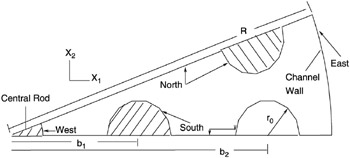
Figure 6.1 shows the smallest symmetry sector of a nuclear rod bundle placed inside a circular channel of radius R. There are nineteen rods: one rod at the channel center, six rods (equally spaced) in the inner rod ring of radius b 1, and twelve rods in the outer ring of radius b 2. The rods are circumferentially equispaced. The radius of each rod is r o . The fluid (coolant) flow is in the x 3 direction. The flow convects away the heat generated by the rods and the channel wall is insulated. It is obvious that a Cartesian grid will not fit the domain of interest because the lines of constant x 1 or x 2 will intersect the domain boundaries in an arbitrary manner. In such circumstances, it proves advantageous to adopt alternative means for mapping a complex domain. These alternatives are to use
curvilinear grids or
finite-element-like unstructured grids.
It is possible to map a complex domain by means of curvilinear grids ( ? 1, ? 2) in which directions of ? 1 and ? 2 may change from point to point. Also, curvilinear lines of...