Introduction to Genetic Algorithms

Including numerous hands-on problems and solutions, this comprehensive book is a helpful guide and a valuable source of information about Genetic Algorithm concepts for their several practical applications.
 TABLE OF CONTENTS
 The objective of VLSI testing is to generate compact set of test vectors that has high coverage of manufacturing defects.
Stuck at fault modeling is the widely used fault modeling method in VLSI Testing.
Here nodes are assumed to be stuck at either "0" or "1", for the purpose fault modeling.
Testing methodology for a digital circuit is shown in Fig. 10.44.
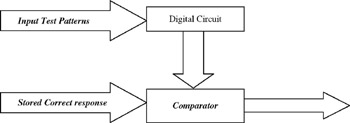
Fig. 10.44: Digital circuit
Test vectors are encoded as Binary bit stream.
Fitness function gives the number of faults covered by each test vector.
Consider the XOR circuit shown in the Fig. 10.45 below.

The description of given XOR Circuit is as follows:
Number of primary inputs is "2" and primary output is "1".
Each parent width is 2 bits.
In this example, XOR circuit has 12 fault sites and 24 stuck at faults.
For a fault free circuit, the output is "1" for a input vector [1,0].
If the circuit has a stuck at "0" at "a", the output response is "0". So input vector [1,0] detects stuck at 0 [SA0] fault at "a".
Like wise [1,0] can also detect SA0 fault at [a, c, d, g, h, z] and SA1 at [b, e, j].
Thus [1,0] can detect 9 out of a total of 24 faults and it's fitness is 0.375 [i.e. 9/24].
The experimental circuit is as given below in Fig. 10.46. Table...