6.1 Volumetric Probability and Probability Density
A probability distribution  over a manifold can be represented by a volumetric probability F( x) , defined through
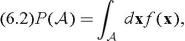
or by a probability density f (x), defined through
where d x= dx 1 dx 2 . While, under a change of variables, a probability density behaves as a density (i.e., its value at a point gets multiplied by the Jacobian of the transformation), a volumetric probability is a scalar (i.e., its value at a point remains invariant: it is defined independently of any coordinate system).
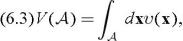
Defining the volume density through
and considering the expression  , we obtain
It follows that the relation between volumetric probability and probability density is
While the homogeneous probability distribution (the one assigning equal probabilities to equal volumes of the space) is, in general, not represented by a constant probability density, it is always represented by a constant volumetric probability.
Although I prefer, in my own work, to use volumetric probabilities, I have chosen in this text to use probability densities (for pedagogical reasons).


 TABLE OF CONTENTS