6.6 Generalized Gaussian
As shown in problem (6.26), among all the normalized probability densities f(x) with fixed ? p-norm estimator of dispersion,
the one with minimum information content (i.e., with maximum spreading ) is given by
where ?( ) denotes the gamma function.
Figure 6.6 shows some examples with p respectively equal to 1, 1.5 , 2, 3 , and 10. For p=1,
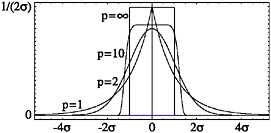 Figure 6.6: Generalized Gaussians of order p (centered at zero). The value p=1 gives a double exponential, p=2 gives an ordinary Gaussian, and p= ? gives a boxcar function. The parameter ? of the figure is the ? p of the text.
 and f 1 (x) is a symmetric exponential, centered at x=x 0 with mean deviation equal to ? 1. For p=2,
and f 2 (x) is a Gaussian function, centered at x=x 0 with standard deviation equal to ? 2. For p ? ?,
and f ? (x) is a box function, centered at x=x 0 with midrange equal to ? ?. Problem (6.32) shows that f p (x) is normalized to unity.
The function f p (x) defined in equation (6.68) can be termed a generalized Gaussian, because it generates a family of well-behaved functions containing the Gaussian function as a particular case. Symmetric exponentials, Gaussian functions, and boxcar functions are often used to model error distribution. The definition of...


 TABLE OF CONTENTS