Inverse Problem Theory and Methods for Model Parameter Estimation

The probability density
is called the ? 2 probability density with parameter ? (one usually says with ? degrees of freedom). Sometimes, the variable u in equation (6.82) is denoted ? 2 (leading to ambiguous notations).
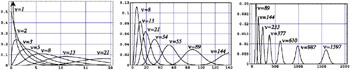
Figure 6.8 displays the ? 2 probability density for some selected values of ?. Note that, for ?=1, the value at the origin is infinite, and that for ?=2, one has the Laplace probability density (exponential law). For large values of ?, the ? 2 probability density can be roughly approximated (near its maximum) by a Gaussian probability density with mean value ? and standard deviation
.
Let y= {y 1 , , y p } be a p-dimensional Gaussian random vector with mean value m and covariance matrix C. With each random realization y 0 of the vector y associate the number
Then, this random variable is distributed according to the ? 2 probability density with p degrees of freedom (see Rao, 1973, or Afifi and Azen, 1979).
Let y be a p-dimensional Gaussian random vector with unspecified mean and with covariance matrix C. Let A be a p q matrix, with p ?q, the matrix A having full rank...