Inverse Problem Theory and Methods for Model Parameter Estimation

6.10: Sequential Random Realization

6.10 Sequential Random Realization

Let us write here the details of the decomposition of a joint probability density as a product of one-dimensional marginals and conditionals.

Let us apply a first time the partition of a joint probability density as the product of a marginal and a conditional. Defining


and


gives


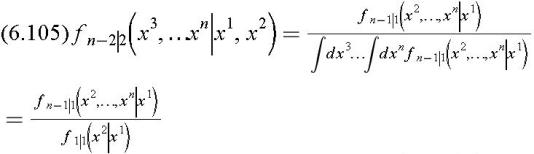
Let us apply the partition again. Defining


and


gives


and, with this, equation (6.103) can be written


Continuing this procedure, one arrives at


expressing the joint probability density as a product of different conditional probability densities.

This immediately suggests a method for generating a random point that only uses one-dimensional random generations. One first generates a random value for x 1 using the unconditional (marginal) density f 1 (x 1 ). This gives some value, say . Given this value, one then generates a random value for x 2 using the conditional probability density . This gives some value, say . Then, one generates a random value for x 3 using , and so on until one generates a random value for x n using .

UNLIMITED FREE
ACCESS
TO THE WORLD'S BEST IDEAS

SUBMIT
Already a GlobalSpec user? Log in.

This is embarrasing...

An error occurred while processing the form. Please try again in a few minutes.

Customize Your GlobalSpec Experience

Category: MRAM
Finish!
Privacy Policy

This is embarrasing...

An error occurred while processing the form. Please try again in a few minutes.