Land Treatment Systems for Municipal and Industrial Wastes
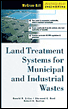
Chapter 3: Wastewater Parameters and System Interactions

Overview

The design approach for any land treatment system is based on the limiting design parameter (LDP) as introduced in Chap. 2. The LDP may be the ability of the soil profile to pass the desired amount of water, or the ability to remove a pollutant to desired levels, or the long-term accumulation of some substance in the soil. Land treatment differs from mechanical wastewater treatment processes in that removal of metals and similar substances is very effective, but these materials may then remain within the soil matrix and their long-term accumulation may limit the useful life of the site and/or its future use for agricultural purposes.

An understanding of the basic interactions between the wastewater parameters of concern and the soil treatment system is essential for the determination of the LDP for a particular design. These interactions are generally the same for all of the land treatment processes and are therefore discussed together in this introductory chapter. The major pollutants of concern can be grouped in nine major categories:

  • Biochemical oxygen demand (BOD 5)

  • Total suspended solids (TSS)

  • Pathogenic organisms

  • Oil and grease

  • Metals

  • Nitrogen

  • Phosphorus

  • Inorganic trace elements and salts

  • Persistent organics

UNLIMITED FREE
ACCESS
TO THE WORLD'S BEST IDEAS

SUBMIT
Already a GlobalSpec user? Log in.

This is embarrasing...

An error occurred while processing the form. Please try again in a few minutes.

Customize Your GlobalSpec Experience

Category: Fixed Growth Treatment Systems
Finish!
Privacy Policy

This is embarrasing...

An error occurred while processing the form. Please try again in a few minutes.