Land Treatment Systems for Municipal and Industrial Wastes

Transmission of wastewater from the point of collection to the land treatment site involves either a pumping station and force-main or a gravity pipeline. The wastewater at the site must then be applied using either a surface or sprinkler distribution system.
Different types of pumping stations are used for transmission, distribution, and tailwater pumping. Transmission pumping of either raw or treated wastewater usually involves a conventional wastewater pumping station.
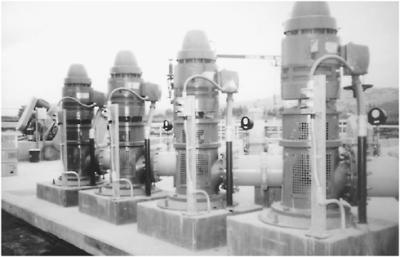
Distribution pumping of treated wastewater can involve either a conventional wastewater pumping station (Fig. 9.1) or a structure built into a treatment and storage pond. Tailwater pumping is used with surface distribution systems and may also be used with some sprinkler distribution systems.
Transmission pumping stations can be located within the wastewater collection system or can be located at the preapplication treatment site if the land application site is remote from the preapplication treatment site. Pumps are usually centrifugal nonclog or vertical turbine.
The number of pumps to be installed depends on the magnitude of the flow and the range of flows expected. Typically the pumps should have capacity equal to the maximum expected inflow with at least one pump out of service.
In pumping stations with capacities of 1 mgd or less usually only two pumps are installed. Each pump should be capable of pumping the maximum inflow. Pumps should be selected with head-capacity characteristics that correspond as nearly as possible to the flow and head requirements of...