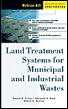
Land Treatment Systems for Municipal and Industrial Wastes
Vegetation plays different roles in each land treatment process. In slow rate (SR) the vegetation is essential and is generally used for nitrogen removal and, in some cases, for economic return. In overland flow (OF) vegetation is the support medium for biological activity and is needed for erosion protection. The grass in OF systems also removes nutrients and slows the flow of wastewater so that suspended solids can be filtered and settled out of the flow stream.
Vegetation is not always part of rapid infiltration (RI) systems. It can play a role in stabilization of the soil matrix and can maintain long-term infiltration rates but does not appear to have a major impact on treatment performance for RI systems.
In this chapter the characteristics of crops that affect their use in land treatment water use and tolerance, nutrient uptake, and toxicity concerns are described. Guidance on crop selection for each land treatment process is provided. Crop management aspects of agronomic and forest crops are also described.
Evapotranspiration (ET) is the combined loss of water from a given area by evaporation from the soil surface, snow, or intercepted precipitation, and by the transpiration and building of tissue by plants. Most water evaporated at plant surfaces is water transpired by the plant, with only about 1 percent of the water taken up by plants actually consumed in the metabolic activity of the plant.1 The evapotranspiration rate is controlled by atmospheric demand and soil-water availability. If soil-water availability...