Linear Systems and Signals Second Edition

4.1: THE LAPLACE TRANSFORM

4.1 THE LAPLACE TRANSFORM

For a signal x( t), its Laplace transform X( s) is defined by


The signal x( t) is said to be the inverse Laplace transform of X( s). It can be shown that [1]


where c is a constant chosen to ensure the convergence of the integral in Eq. (4.1), as explained later.

This pair of equations is known as the bilateral Laplace transform pair, where X( s) is the direct Laplace transform of x( t) and x( t) is the inverse Laplace transform of X( s). Symbolically,


Note that


It is also common practice to use a bidirectional arrow to indicate a Laplace transform pair, as follows:


The Laplace transform, defined in this way, can handle signals existing over the entire time interval from ? ? to ? (causal and noncausal signals). For this reason it is called the bilateral (or two-sided) Laplace transform. Later we shall consider a special case-the unilateral or one-sided Laplace transform-which can handle only causal signals.

LINEARITY OF THE LAPLACE TRANSFORM

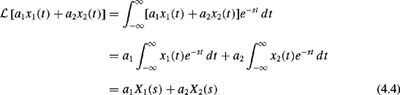
We now prove that the Laplace transform is a linear operator by showing that the principle of superposition holds, implying that if


then


The proof is simple. By definition


This result can be extended to any finite sum.

THE REGION OF CONVERGENCE (ROC)

The region of convergence (ROC), also called the region of...

UNLIMITED FREE
ACCESS
TO THE WORLD'S BEST IDEAS

SUBMIT
Already a GlobalSpec user? Log in.

This is embarrasing...

An error occurred while processing the form. Please try again in a few minutes.

Customize Your GlobalSpec Experience

Category: IC Electronic Filters
Finish!
Privacy Policy

This is embarrasing...

An error occurred while processing the form. Please try again in a few minutes.