Linear Systems and Signals Second Edition

Chapter 8: Sampling-The Bridge From Continuous to Discrete

OVERVIEW

A continuous-time signal can be processed by processing its samples through a discrete-time system. For this purpose, it is important to maintain the signal sampling rate high enough to permit the reconstruction of the original signal from these samples without error (or with an error within a given tolerance). The necessary quantitative framework for this purpose is provided by the sampling theorem derived in Section 8.1.

The sampling theory is the bridge between the continuous-time and the discrete-time worlds. The information inherent in a sampled continuous-time signal is equivalent to that of a discrete-time signal. A sampled continuous-time signal is a sequence of impulses, while a discrete-time signal presents the same information as a sequence of numbers. These are basically two different ways of presenting the same data. Clearly, all the concepts in the analysis of sampled signals apply to discrete-time signals. We should not be surprised to see that the Fourier spectra of the two kinds of signal are also the same (within a multiplicative constant).

8.1 THE SAMPLING THEOREM

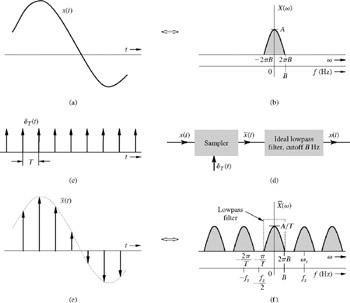
We now show that a real signal whose spectrum is bandlimited to B Hz [ X ( ?)= 0 for ? > 2 ? B] can be reconstructed exactly (without any error) from its samples taken uniformly at a rate f s > 2 B samples per second. In other words, the minimum sampling frequency is f s= 2 B Hz. [ ]


Figure 8.1: Sampled signal and its...

UNLIMITED FREE
ACCESS
TO THE WORLD'S BEST IDEAS

SUBMIT
Already a GlobalSpec user? Log in.

This is embarrasing...

An error occurred while processing the form. Please try again in a few minutes.

Customize Your GlobalSpec Experience

Category: Digital-to-Analog Converters
Finish!
Privacy Policy

This is embarrasing...

An error occurred while processing the form. Please try again in a few minutes.