Linear Systems and Signals Second Edition

4.3: SOLUTION OF DIFFERENTIAL AND INTEGRO-DIFFERENTIAL EQUATIONS

4.3 SOLUTION OF DIFFERENTIAL AND INTEGRO-DIFFERENTIAL EQUATIONS

The time-differentiation property of the Laplace transform has set the stage for solving linear differential (or integro-differential) equations with constant coefficients. Because d ky/ dt k s kY( s), the Laplace transform of a differential equation is an algebraic equation that can be readily solved for Y( s). Next we take the inverse Laplace transform of Y( s) to find the desired solution y( t). The following examples demonstrate the Laplace transform procedure for solving linear differential equations with constant coefficients.

EXAMPLE 4.10

Solve the second-order linear differential equation


for the initial conditions y(0 ?) = 2 and and the input x( t) = e ?4 t u( t).

The equation is


Let


Then from Eqs. (4.24)


and


Moreover, for x( t) = e ?4 t u( t),


Taking the Laplace transform of Eq. (4.35b), we obtain


Collecting all the terms of Y( s) and the remaining terms separately on the left-hand side, we obtain


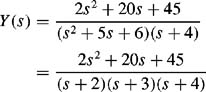
Therefore


and


Expanding the right-hand side into partial fractions yields


The inverse Laplace transform of this equation yields


Example 4.10 demonstrates the ease with which the Laplace transform can solve linear differential equations with constant coefficients. The method is general and can solve a linear differential equation with constant coefficients of any order.

Zero-Input and Zero-State Components of Response

The Laplace transform method gives...

UNLIMITED FREE
ACCESS
TO THE WORLD'S BEST IDEAS

SUBMIT
Already a GlobalSpec user? Log in.

This is embarrasing...

An error occurred while processing the form. Please try again in a few minutes.

Customize Your GlobalSpec Experience

Category: IC Electronic Filters
Finish!
Privacy Policy

This is embarrasing...

An error occurred while processing the form. Please try again in a few minutes.