Linear Systems and Signals Second Edition

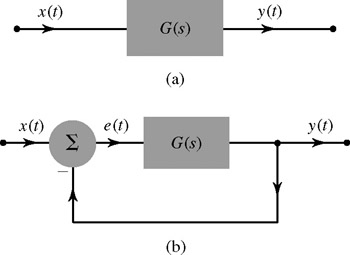
Generally, systems are designed to produce a desired output y( t) for a given input x( t). Using the given performance criteria, we can design a system, as shown in Fig. 4.33a. Ideally, such an open-loop system should yield the desired output. In practice, however, the system characteristics change with time, as a result of aging or replacement of some components or because of changes in the environment in which the system is operating. Such variations cause changes in the output for the same input. Clearly, this is undesirable in precision systems.
A possible solution to this problem is to add a signal component to the input that is not a predetermined function of time but will change to counteract the effects of changing system characteristics and the environment. In short, we must provide a correction at the system input to account for the undesired changes just mentioned. Yet since these changes are generally unpredictable, it is not clear how to preprogram appropriate corrections to the input. However, the difference between the actual output and the desired output gives an indication of the suitable correction to be applied to the system input. It may be possible to counteract the variations by feeding the output (or some function of output) back to the input.
We unconsciously apply this principle in daily life. Consider an example of marketing a certain product.