Linear Systems and Signals Second Edition

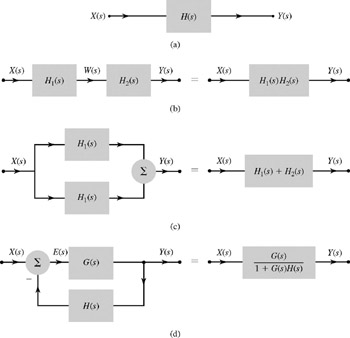
Large systems may consist of an enormous number of components or elements. As anyone who has seen the circuit diagram of a radio or a television receiver can appreciate, analyzing such systems all at once could be next to impossible. In such cases, it is convenient to represent a system by suitably interconnected subsystems, each of which can be readily analyzed. Each subsystem can be characterized in terms of its input-output relationships. A linear system can be characterized by its transfer function H( s). Figure 4.18a shows a block diagram of a system with a transfer function H( s) and its input and output X( s) and Y( s), respectively.
Subsystems may be interconnected by using cascade, parallel, and feedback interconnections (Fig. 4.18b, 4.18c, 4.18d), the three elementary types. When transfer functions appear in cascade, as depicted in Fig. 4.18b, then, as shown earlier, the transfer function of the overall system is the product of the two transfer functions. This result can also be proved by observing that in Fig. 4.18b
We can extend this result to any number of transfer functions in cascade. It follows from this discussion that the subsystems in cascade can be interchanged without affecting the overall transfer function. This commutation property of LTI systems follows directly from the commutative (and associative) property of convolution. We have already proved this property in Section 2.4-3. Every possible...