Linear Systems and Signals Second Edition

4.2: SOME PROPERTIES OF THE LAPLACE TRANSFORM

4.2 SOME PROPERTIES OF THE LAPLACE TRANSFORM

Properties of the Laplace transform are useful not only in the derivation of the Laplace transform of functions but also in the solutions of linear integro-differential equations. A glance at Eqs. (4.2) and (4.1) shows that there is a certain measure of symmetry in going from x( t) to X( s), and vice versa. This symmetry or duality is also carried over to the properties of the Laplace transform. This fact will be evident in the following development.

We are already familiar with two properties; linearity [Eq. (4.4)] and the uniqueness property of the Laplace transform discussed earlier.

4.2-1 Time Shifting

The time-shifting property states that if


then for t 0 ? 0


Observe that x( t) starts at t = 0, and, therefore, x( t ? t 0) starts at t = t 0. This fact is implicit, but is not explicitly indicated in Eq. (4.19a). This often leads to inadvertent errors. To avoid such a pitfall, we should restate the property as follows. If


then


Proof.


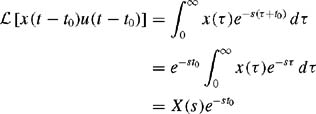
Setting t ? t 0 = ?, we obtain


Because u( ?) = 0 for ? < 0 and u( ?) = 1 for ? ? 0, the limits of integration can be taken from 0 to ?. Thus


Note that x( t ? t 0) u( t ? t 0

UNLIMITED FREE
ACCESS
TO THE WORLD'S BEST IDEAS

SUBMIT
Already a GlobalSpec user? Log in.

This is embarrasing...

An error occurred while processing the form. Please try again in a few minutes.

Customize Your GlobalSpec Experience

Category: IC Electronic Filters
Finish!
Privacy Policy

This is embarrasing...

An error occurred while processing the form. Please try again in a few minutes.