Maintainability, Availability & Operational Readiness Engineering Handbook, Volume 1

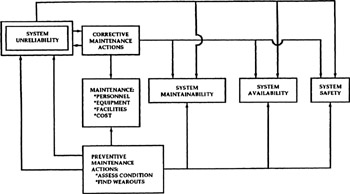
Maintenance is defined as any action which retains non-failed units in a reliabilitywise and safetywise satisfactory, operational condition; and if they have failed, restores them to a reliabilitywise and safetywise satisfactory, operational condition. It involves fixing up partial failures or incipient failures of independently operating subsystems of the system and in the system's redundant elements without preferably interrupting system operation. Maintenance is a vital part of the cycles of unreliability, maintainability, availability, and safety, as shown in Fig. 3.1. It looks simultaneously at downtime, maintenance man-hours, and maintenance dollars.
The previous definition of maintenance implies two types of maintenance actions: (1) preventive or scheduled, and (2) corrective or unscheduled, The various preventive and corrective maintenance times, and their relationships to all other times associated with the life of a unit are given in Fig. 3.2.
Preventive maintenance is performed on satisfactorily functioning units at regularly scheduled intervals, and includes, but is not limited to, the following actions:
Servicing periodically, such as replenishing depleted oil, changing aged oil, greasing and lubricating, refueling, cleaning, adjusting, aligning, checking and cleaning electrical contact surfaces, removing rust deposits, tightening loose units, making routine checks and calibrating.
Inspecting, checking out, replacing or repairing failed redundant units.
Replacing components before they enter their prescribed...