Maintainability, Availability & Operational Readiness Engineering Handbook, Volume 1

14.4: PREVENTIVE MAINTENANCE POLICIES AND SPARES PROVISIONING

14.4 PREVENTIVE MAINTENANCE POLICIES AND SPARES PROVISIONING

14.4.1 AGE REPLACEMENT POLICY - POLICY I

A unit is replaced preventively once it has reached a specified age, T p and correctively whenever it fails before age T p [See Section 9.2]. The optimal replacement age, T p*, is so determined that the total expected cost per unit operating time is minimized using Eq. (9.31), or

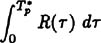
To determine the spares needed for corrective and preventive maintenance of a unit, its corrective and preventive replacement rates need to be known. Since the term

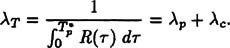
gives the mean time between both preventive replacements and corrective failures, the total replacement rate, ? T, is given by Eq. (9.22), or

As defined in Section 9.5 the total average number of spares over a long period of operation of the equipment, say t hours, is given by

The total number of spares at the confidence level, CL = 1 ? ?, is obtained from Eq. (9.29) by solving for N SP which is the actual number of spares, or

EXAMPLE 14-7

Consider Example 9-3 and the system of Fig. 9.12. Determine the total average number of spares for a period of 10,000 hr and the number of spares at a 95% confidence level.

SOLUTIONS TO EXAMPLE 14-7

  1. In Example 9-3 the stabilized preventive maintenance, or replacement rate, is calculated from

    or

    The stabilized corrective failure rate is calculated from

    or

    Then, the total average number of spares for a period

UNLIMITED FREE
ACCESS
TO THE WORLD'S BEST IDEAS

SUBMIT
Already a GlobalSpec user? Log in.

This is embarrasing...

An error occurred while processing the form. Please try again in a few minutes.

Customize Your GlobalSpec Experience

Category: Vacuum Equipment Repair Services
Finish!
Privacy Policy

This is embarrasing...

An error occurred while processing the form. Please try again in a few minutes.