14.2 SPARES PROVISIONING FOR A DECAYING POPULATION
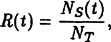
When dealing with a decaying population of identical units the failed units are not replaced or maintained as soon as they fail. To find the number of units which should start a mission, or the number of missions one unit undertakes, N T, to end up with the desired number at the end of the mission or the number of successful missions, N S( T), use
or
The number of units that will fail, N F, and need to be spared would be given by
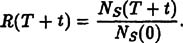
The conditional reliability function, R( T, t), may be used to find the number of units which should start the new mission, starting at the age T, N S( T), to end up with the desired number at the end of the new mission of t duration, N S( T + t), and the number that should start at age zero, N S(0), to end up with desired number at the end of the new mission, N S( T + t), and vice versa. By definition the conditional reliability is given by
Also
From Eq. (14.9) the number of units which should start the new mission at age T, N S( T), is given by
Also, by definition,
Therefore, the number of units that should start at age zero, N S(0), is given by
EXAMPLE 14-5
The times-to-failure distribution...


 TABLE OF CONTENTS