Maintainability, Availability & Operational Readiness Engineering Handbook, Volume 1

To minimize both preventive and corrective maintenance times, personnel, skill levels, equipment and spares, the following design criteria should be adhered to:
Provide diagnostic aids for rapid and positive fault identification.
Make sure units are accessible for ease of trouble-shooting, removal and replacement.
Package functions into modules that are separable with minimum interconnections.
Standardize piece-parts and components as much as possible.
Standardize required tools.
Provide good identification of parts and test points and locate labels where they can be seen.
Make sure connectors cannot be inadvertently interchanged.
Provide fasteners and lugs which facilitate maintenance.
So locate multiple connectors that they can be easily grasped for tight assembly and ease of disassembly.
Locate check points, adjustment points, cables and connectors for ease of maintenance and reduction of downtime.
Identify circuit breakers properly, in addition to reference designation.
Mount polarized electric components consistently for ease of operation and maintenance.
Correctly number the parts according to circuit data flow and their physical location.
Provide rests on which subassemblies can be placed to perform the required maintenance without damaging their parts and components.
Be sure maintenance can be performed without endangering personnel or system safety.
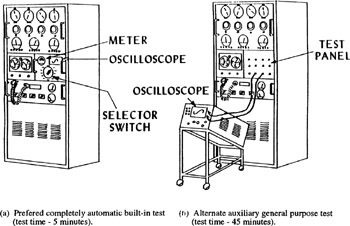
Figure 4.1 (a) illustrates one way of providing a more efficient, tailored, completely automatic, built-in test unit which requires only five minutes to diagnose the cause of failures of electronic equipment, as opposed to using an auxiliary, general purpose test set-up, shown in Fig. 4.1 (b), which requires 45 minutes to perform the same diagnostic tasks.