Maintainability, Availability & Operational Readiness Engineering Handbook, Volume 1

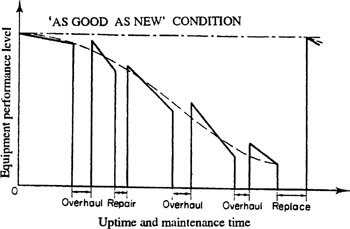
Overhaul is a maintenance activity undertaken at scheduled time intervals whose primary purpose is to reduce the number of failures and prevent equipment from reaching the age at which frequent failures cause substantial loss of performance. In comparison with the preventive maintenance policies, given in Chapters 9, 10, 11 and 12 by which a component, an equipment or a system is restored to "as good as new" condition after replacement or repair, an overhaul action is considered as a restorative action which does not return an equipment to "as good as new" condition but improves its performance. Figure 13.1 illustrates the effect of overhaul and repair on the equipment's condition. It may be seen that there is gradual deterioration of the equipment's performance over time which ends eventually in the replacement of the whole equipment.
In contrast to preventive maintenance policies where the criteria are most often to determine the optimum replacement or repair schedule so that the total cost per unit of operating time is minimized, an overhaul strategy is based on making decisions whether, and when, to overhaul, as well as the level of overhaul to which equipment is to be repaired. Overhaul versus replacement and repair is a decision most often based on minimization of future cost, maximization of future benefits or reducing the failure rate to acceptable levels. The decision is usually made at regular time intervals so that the loss of production due...