Mass Spectrometry: A Foundation Course

3.3: MASS ANALYSERS

3.3 MASS ANALYSERS

Once ions have been formed and introduced into a mass spectrometer, a mass analyser is used to separate them based upon their mass-to-charge ratio through the application of electric and magnetic fields. There are a number of different mass analysers described in the following subsections. Many modern instruments feature several mass analysers coupled together for use in tandem mass spectrometry (see Chapter 4) and other applications. When a mass spectrometer is constructed of several mass analysers of a different type, it is referred to as a hybrid instrument. This section begins with the simplest mass analyser, the time-of-flight tube.

3.3.1 Time-of-Flight

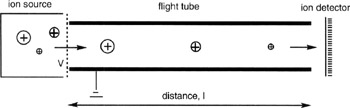
As the name implies, time-of-flight (TOF) mass spectrometers separate ions and measure their m/z based on the time they take to pass ("fly") from the ion source to the detector. The flight tube is usually 1 2 m in length and the basis of the separation makes no use of either electric or magnetic fields. Ions are separated in the field-free region of the flight tube before reaching the detector. A simple representation of a TOF mass spectrometer is shown in Figure 3.12.


Figure 3.12: Representation of a time-of-flight (TOF) mass spectrometer

Ions are first formed in the source and then "pushed" down the flight tube through the application of a high accelerating potential (V) of the same polarity of the ions applied to a lens or grid. The kinetic energy of ions of mass, m, and charge, z, is given by...

UNLIMITED FREE
ACCESS
TO THE WORLD'S BEST IDEAS

SUBMIT
Already a GlobalSpec user? Log in.

This is embarrasing...

An error occurred while processing the form. Please try again in a few minutes.

Customize Your GlobalSpec Experience

Category: Mass Spectrometers
Finish!
Privacy Policy

This is embarrasing...

An error occurred while processing the form. Please try again in a few minutes.