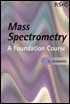
Mass Spectrometry: A Foundation Course

Chapter 5: Organic Mass Spectrometry

5.1 ACCURATE MASS MEASUREMENTS

The molecular weight of a compound alone can be useful for identifying an organic compound. Where this measurement is made with high mass resolution, the molecular weight of a compound can be measured to an accuracy of a few parts-per-million (ppm). The experiment is referred to as an accurate mass measurement.

As described in Chapter 1, Section 1.3.1, this information can be sufficient to derive the molecular formula for the compound provided that two or more possible elemental compositions are distinguishable by mass within the error of the measurement. Benzene, with an elemental formula of C 6H 6, will give rise to a singly-charged ion with a resolved monoisotopic mass of 78.0468 based on the masses for the 12C and 1H isotopes (12.0000 and 1.0078 respectively). A mass measurement of within 149 ppm would be required to distinguish this ion from that of chloropropane (C 3H 7Cl) with a monoisotopic mass of 78.0235. This value reflects one-half of the difference between the two masses divided by the mass of benzene.

5.1.1 Calibrating the Mass Scale

To measure the m/ z ratio of an ion with high accuracy, it is necessary to calibrate the mass scale of the instrument by analysing a mixture of known compounds that produce ions across the mass scale. On a magnetic-based instrument, for a fixed accelerating voltage, the magnetic field strength ( B) is corrected (to those values predicted from equation 3.22) to...

UNLIMITED FREE
ACCESS
TO THE WORLD'S BEST IDEAS

SUBMIT
Already a GlobalSpec user? Log in.

This is embarrasing...

An error occurred while processing the form. Please try again in a few minutes.

Customize Your GlobalSpec Experience

Category: Mass Spectrometers
Finish!
Privacy Policy

This is embarrasing...

An error occurred while processing the form. Please try again in a few minutes.